Victor Cheeney
Triathlete & Founder of Live Video Feedback
Why Watching Yourself Exercise Matters
When I was going through rehab, my physio kept saying my form was off. I couldn't feel it. I thought I was doing everything right. Then I actually watched myself on video and understood what he meant immediately - my hip was dropping on every single rep, and I had no idea.
That gap between what your body thinks it's doing and what it's actually doing is the whole problem. And the way you close that gap matters more than most people realize.
What proprioception actually is
Your body has an internal sense of where it is in space. That's proprioception. When you close your eyes and touch your nose, you're using it. When you squat and feel (or think you feel) your knee tracking over your toes, that's proprioception too.
The problem is that proprioception lies. After an injury, this system gets disrupted. Swelling, scar tissue, and altered movement patterns all mess with the signals your body sends. Your knee might feel straight while it's caving in. Your back might feel flat when it's rounding. You can't fix what you can't feel.
Visual feedback acts as a second reference point. When you can see your movement in real time, your brain gets an external signal that can confirm or correct what proprioception is telling it.
Why watching yourself live is different from watching a recording
This is the part that surprised me when I looked into it. It seems obvious that live feedback and delayed feedback are both "visual feedback," so they should work equally well. They don't.
Motor learning research makes a distinction between concurrent feedback (during the movement) and terminal feedback (after). Both help. But for skill acquisition and form correction, concurrent feedback tends to produce faster improvement - especially early on, when you're learning a new movement pattern or relearning one after injury.
The reason is timing. When you see something wrong while you're still moving, you can correct it on the next rep - or even mid-rep. When you watch a recording afterward, there's a delay between the error and the correction. You have to remember what the movement felt like, map that to what you saw on the recording, and then apply that to your next attempt. That's a lot of cognitive work, and a lot of opportunities for the correction to get lost.
Planned Media
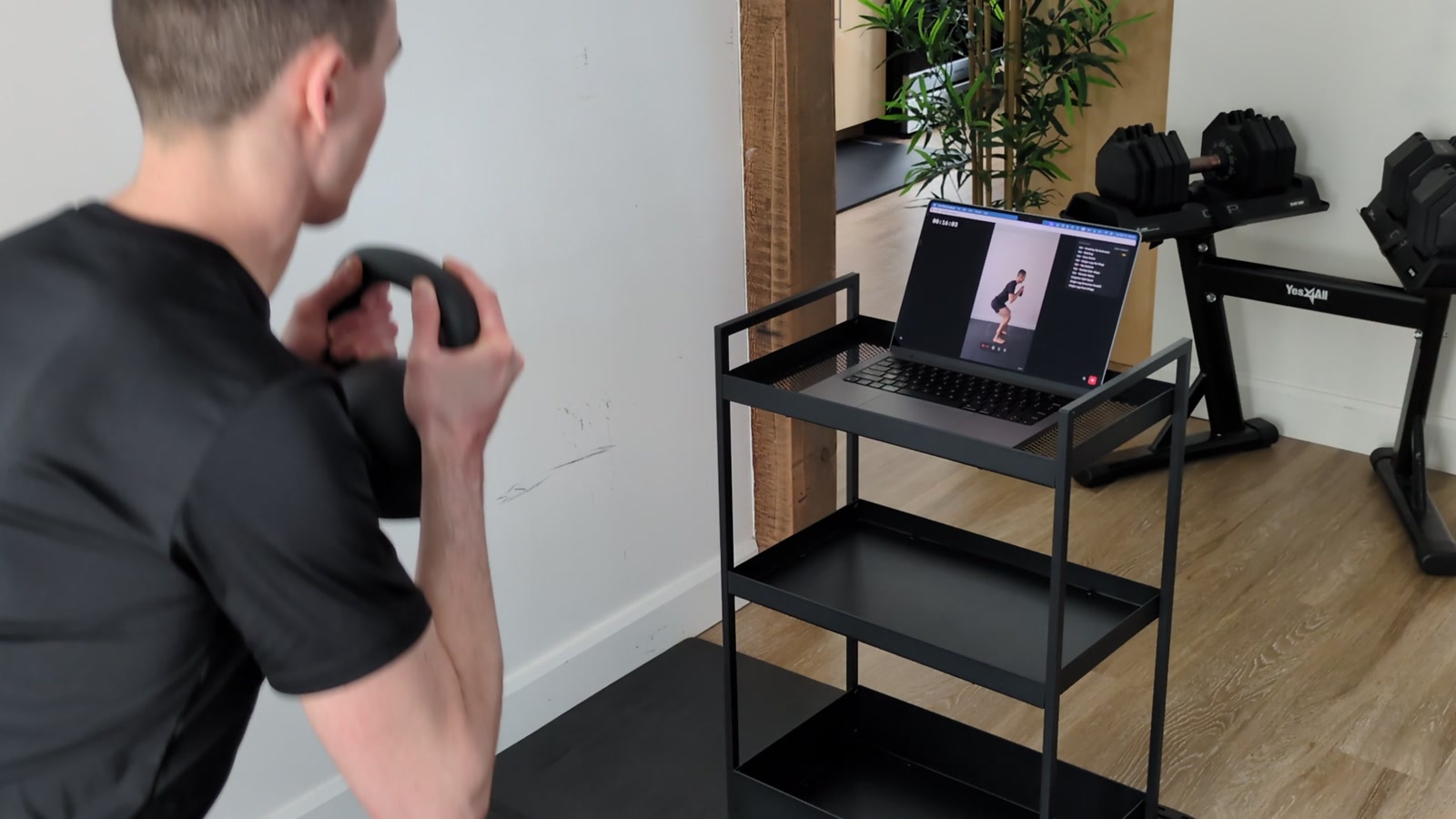
Live feedback during exercise
Video showing real-time form feedback while exercising
The mirror problem
Mirrors seem like the obvious solution. And they do help, for some exercises. The trouble is that using a mirror changes your movement. You turn your head to see yourself, which shifts your neck, which affects your shoulder position, which ripples through your whole posture. A side-view mirror is almost useless for checking your squat depth because you can't see the side of yourself without twisting.
You also can't set up a mirror in every position you need to train. Floor exercises, prone work, anything in a small space - mirrors don't help.
A camera filming from the relevant angle, streaming to a screen in your line of sight, solves all of this. You keep your head position, you get the exact angle you need, and you can see yourself without altering the movement you're trying to observe.
Mirror neurons and learning by watching
There's a related concept worth understanding: mirror neurons. These are brain cells that fire both when you perform an action and when you observe it. They're part of why watching expert athletes helps your own performance, and why video analysis is a standard tool in professional coaching.
When you watch yourself moving correctly - in real time - you're reinforcing that pattern neurologically. The observation feeds back into the execution. Over many reps, this tightens the loop between intention and output.
This is also why watching a recording of a bad rep isn't neutral. You're reinforcing the wrong pattern visually, even as you're trying to correct it. Recording blind and reviewing later gives you information, but watching yourself live gives you both information and the neurological benefit of real-time correction.
What this actually looks like in practice
I'm not trying to turn this into a neuroscience lecture. Here's what it means practically:
- Set up a view of yourself before you start exercising, not after
- Position the camera to show the joint and movement you're working on
- Look at the screen during the movement, not at the floor or the mirror
- Use the feedback in real time - adjust your position, check your alignment, correct before you finish the rep
When I started watching myself live during rehab exercises, the quality of my reps improved noticeably within the first session. Not because I was doing something different - because I could see what I was doing and make corrections I couldn't make before.
Planned Media
Live correction visual
Need: side-by-side or over-the-shoulder still that shows form correction happening during the rep, not setup.
Recording still has a place
None of this means recording is useless. Your physio needs clips to review between sessions. You want to track progress over time. Recordings are essential for that.
But recording alone - filming blind, walking back to check, re-recording, repeating - doesn't give you the live feedback loop that actually improves form during the session. It gives you evidence of what happened, not a tool to fix it while it's happening.
The ideal setup combines both: watch yourself live while you move, and record the session so you have clips to review and share. If you want the full workflow for sending those clips to your PT, there's a separate guide on that here.
The setup barrier
The reason most people don't watch themselves live is that it's genuinely inconvenient. You'd need your phone propped up as a camera, and then somehow have that stream visible on a larger screen while you exercise. Airplay? Screen mirroring? It works, sort of, but there's lag, the setup is fiddly, and you're burning through your phone battery.
That friction is why I built Live Video Feedback. Your phone connects via QR code and streams to your laptop as a low-latency live camera. No cables, no complicated setup, no lag. You watch yourself on your laptop screen while you move, record with one key, and trim with one key when you're done. The whole point was to remove the barrier between "I know real-time feedback helps" and "I can actually use it in every session."
I built Live Video Feedback after my own injury.